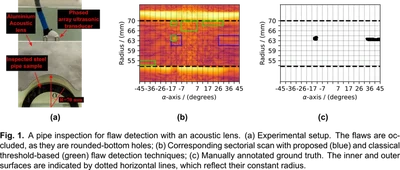
Machine learning–driven flaw detection for ultrasonic pipe inspections with acoustic lens
Anomaly-detection models to help flaw detection process.
Master’s Student
LASSIP — Laboratory of Statistical Signal Processing & Inverse Problems
Hi! I’m Thiago, a graduate researcher at the UTFPR, currently pursuing an M.Sc. in Computer Engineering in the Graduate Program in Electrical and Computer Engineering. My work is at the intersection of inverse problems and signal processing, mostly applied to ultrasonic imaging for non-destructive testing.
For the past few years, I’ve been part of AUSPEX, a Petrobras-funded project at the Laboratory of Statistical Signal Processing and Inverse Problems (LASSIP). There, I help developing new ultrasound techniques to inspect subsea pipelines faster and more reliably.
I’m particularly interested in using signal processing and physics-based models to extract meaningful information from sensor data in real-world environments. I find it fascinating that algorithms and sensing systems allow us to infer quantities that are hard (or impossible) to measure directly, and how this can directly support real-world decision-making.
You can check out more about my academic journey below. Feel free to reach out at thiagokalid@alunos.utfpr.edu.br. I’d love to connect!
BS in Electrical Engineering
2019-03-01
2025-03-27
Federal University of Technology - Paraná (Brazil)
MS in Electrical Engineering
2025-03-27
2027-03-01
Federal University of Technology - Paraná (Brazil)
I am passionate about applying complex mathematical modeling to solve real-world problems. For this reason (along with a bit of life’s randomness), I naturally gravitated toward the intersection of signal processing and inverse problems, primarily in ultrasound imaging for NDT.
More recently, I have enjoyed studying ultrasound simulation methods, such as ray tracing and finite-element-based methods, to enhance my understanding of the physics behind sound propagation.
While these are the areas I have worked on so far, one of the things that I most enjoy is studying new subjects and concepts.
Some interesting academic projects I’ve worked on that did not lead (yet) to formal publications.
Anomaly-detection models to help flaw detection process.
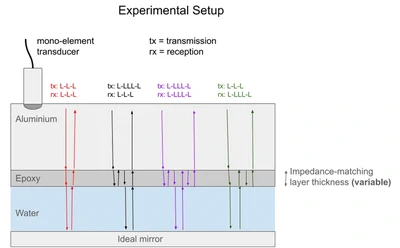
Understanding impedance-matching layer and how they can improve ultrasound inspections.
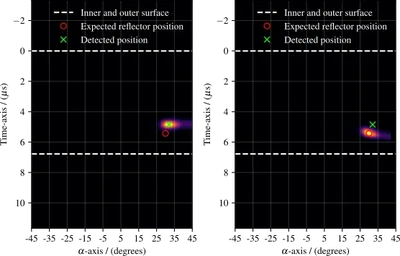
Mitigating ultrasound image distortions on through thin-plate spline.
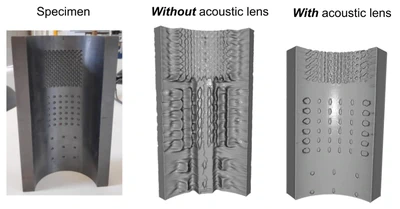
Ultrasound imaging of pipes using our proposed acoustic lenses.
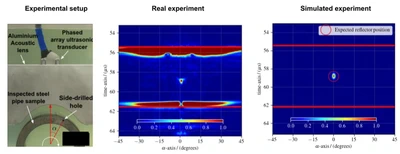
A simplified simulator to help us to design better acoustic lenses.
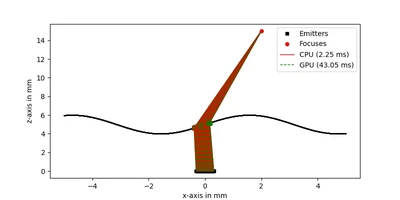
A parallel GPU ray-tracing algorithm for ultrasound imaging.
I'm always open to discussing new projects, opportunities, or just having a chat.