Inverse-based ultrasound imaging through linear programming
Abstract
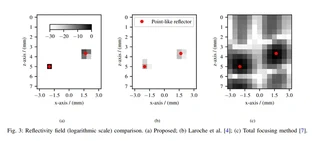
Ultrasound image reconstruction is typically performed through delay-and-sum: they are linear and computationally efficient algorithms. However, images produced by this family of methods contain oscillation that limits the imaging resolution–a phenomenon especially problematic when imaging very close point-like reflectors. Inverse-based methods have been proven to enhance imaging resolution by reducing high-frequency oscillations. They incorporate specific prior information and reduce oscillations by proper regularization. Although the regularization reduces oscillations, it also attenuates the signal of interest. We are proposing an inverse-based method without regularization. It is a linear programming-based approach: the inverse-problem is modeled as the minimization of the $\ell_1$ norm of a residue, which is solved through linear programming. We compared our methods to delay-and-sum and inverse-based imaging algorithms by simulating a steel specimen with point-like reflectors. Our method outperforms classical algorithms regarding SNR and resolution but at a higher computational cost.
